Tuesday, September 13, 2011

Is Lifting Weights Enough for Good Health?

Obviously, engaging in a weight training regimen provides an individual with benefits. Training results in increased muscle strength, which allows an individual greater functionality in every day life. This could be due to an increased ability to move around heavy objects, or a slowing of functional decline that accompanies age. In addition, weight training can improve muscle coordination and help protect against injury. However, to have a fully-rounded and healthy exercise program, aerobic training is a must.

The reason aerobic training (such as running, walking, cycling, swimming, etc) is so important is because it fills in all the "blanks" left by solely engaging in weight lifting. Numerous studies have shown weight training not to significantly increase any markers of increased cardiovascular fitness, which is crucial to preventing cardiovascular diseases such as atherosclerosis. Weight training (to any significant or conclusive degree) does not improve markers of cardiovascular fitness, such as resting heart rate, blood pressure, stroke volume of the heart, blood lipid profile, or cardiac function. While there may be bodily responses in these elements directly during the workout, these do not carry over once the exercise is finished.

To improve these markers of cardiovascular fitness chronically in your body, aerobic training is necessary. Exercise such as running, walking, and others listed above all work these bodily systems, causing adaptations that stay with your body after the workout is done. Just thirty minutes of exercise a few times every week is sufficient to cause beneficial changes, although more is always better.

Weight training creates adaptations in the body that causes increased health and everyday functioning, but it is aerobic exercise that is needed to help stave off a multitude of other ailments that can come with age, poor diet, or genetics, such as hypertension, high cholesterol, or cardiovascular disease. Weight training is a good start to a healthy exercise program, but aerobic exercise is crucial for it to be maximally beneficial.

Tuesday, July 26, 2011

Exercising In The Heat

Last Thursday, in the midst of the intense heat wave smothering a significant swath of the United States, I had the unfortunate luck to have only a window of time from 2:30 to 4:00 PM to fit in my exercise. Being an avid runner, this meant being out in 100 degree weather for nearly an hour and a half. Exercising in the heat is not an easy thing to do, and it can be difficult to do safely and effectively in such extreme weather. However, it is possible to get your workout done in this any other degree of heat, if a specific set of rules is followed. Abiding by them allows you to get your needed exercise in, even in the heat of summer. Following these rules is the only thing that allowed me to complete me run, and doing so allowed me to complete it safely. These rules are:

Stay Hydrated
Keeping your body filled with water is far and away the most important aspect of exercising in the heat. The human body can sweat up to 2.5 liters per hour in hotter conditions or higher intensities. That's 2/3 of a gallon, or 85 oz. Staying hydrated is beyond crucial. Drinking some extra fluids immediately before exercising as well can top off your stores. I considered this step my number one priority prior to leaving on my run last Thursday.

Don't Push Yourself Too Hard
Extreme heat is not the time to up the intensity of your exercise unless you are very, very used to the conditions. Higher intensity means a significantly higher sweat rate and risk of dehydration. Your muscles work harder in the heat as well, so your ability to perform will be lessened. Hotter wealth is not the time to push yourself but to just slow down, take things easy, and save your harder workout for another day.

Monitor Yourself
Keep an eye on how your body feels. If dehydration is coming, you want to know it. Symptoms of dehydration can include: dry mouth, nausea, muscle cramps, lightheadedness, and weakness, and decreased urine output. Note: you become thirsty after reaching a moderately dehydrated point. Don't wait for your thirst to show before drinking water.


Use The Proper Equipment
Try use as limited clothing as possible, and use cooler, lighter options when possible. Also, if you are exercising for a longer period of time, a handheld water bottle might be a good option to carry with you. Another thing to keep in mind is the sun; on a hot day, you can get sunburned. Sunscreen is an often overlooked, but important, item to use.


Replenish What You Lose
It goes without saying that you need to drink water after your exercise. Your thirst alone will tell you that. People often don't consider that you need to replace other things as well, such as electrolyte stores. Sodium, one electrolyte, is lost in sweat in large quantities, and potassium is lost as well to a smaller degree. Lower or unbalanced amounts of these two minerals can result in painful muscle cramps, both during and after exercise. Eat some salty foods, or eat high potassium ones such as bananas and oranges. Electrolyte loss during exercise can be almost as dangerous as water loss, and is something to keep track of.

Avoid The Hotter Parts Of The Day
The morning and evening are the coolest parts of the day, and this is absolutely something to take advantage of. Try and organize your schedule so you exercise around these times, if possible. This can make a huge difference. If you must exercise at hotter times, like I had to last Thursday, make sure to follow the previously rules even more stringently.

Running in the heat of summer is harder, but definitely doable. More caution and planning is needed to be safe, but if care is taken the heat won't be able to put the brakes on your workout. Simply follow the steps above, and you can get through your workout in any hot temperature!

Monday, July 11, 2011

The Most Common Mistake Beginning Runners Make

How many times have you heard someone say, "yeah I would love to be able to run regularly, but I've tried to run a couple times and it's just so hard!" Variations of this excuse are probably the number one reason that people don't continue running once they start. Have you had this problem before? If so, there's a very simple solution:

Run slower.

A significant portion of the time, the reason that running is "so hard" is because the person is running too fast. If half a mile, one mile, two miles into your run you are already gasping for breath, then you are working too hard. If you go out for a normal run, you should be running at a pace slow enough that you would be able to talk to someone without gasping for air. If you can't, you need to go a little easier.

People seem to think that just because they are out of shape, running should be difficult. No matter what your fitness is, however, you can always find a pace that isn't too taxing. I told my mother this when she first started running, and her response was, "but I would be running so slowly! I'm already not that fast as it is!" Hey, your pace is your pace. Pushing yourself too hard every run may make you feel faster, but it won't change the speed you can (or should) actually be running at.

It is very easy to run once, get a certain pace, and then try and stick with that pace or beat it no matter how hard that goal is. After all, no one wants to have run slower on a run than they did before. Sometimes I would ask my mom how her run went, and she would say, "Good! I ran that loop a minute faster than I usually do!" This mentality means you are pushing yourself too much. At the proper pace, shaving a minute off of you normal loop time should feel like an absolute piece of cake. Here's a tip instead: leave the watch at home and run by feel; the only thing your time can do is make you run faster than you should. Just slow down the pace, and you will be pleasantly surprised with just how long you will be able to run for.

Sunday, June 26, 2011

The Myth of the "Fat Burning" Setting

Ok, so you just got to the gym to do your workout, and you hop on the bike all ready to get going. First, though, the machine tells you that you have to choose a "zone" to exercise in: either the "fat burning" zone or the "cardio" one. Since you're looking to lose a little weight, you set it to the "fat burning" setting in the attempt to hit those problem areas you just can't seem to get rid of. Plus, today you just don't really feel like suffering though the more intense "cardio" workout that the bike has. You can work on your fitness later, after all; right now you just want to lose some weight.

Oops! You just got sucked into one of the biggest exercise errors that people make.

How is that possible? Well, there is a reason that the "fat burning" setting on the bike (or treadmill, elliptical, etc) is easier to use than the "cardio" setting. It's because it takes less energy for your body to accomplish. Less energy means less stored fuel is being used up during your workout. So overall, if you use the "fat burning" session, it means you are burning fewer calories.

Hey, wait a sec! Why is the machine telling me I'm burning fat if I'm using less calories? Because, this isn't technically a lie. At lower intensities of exercise, your body is burning a higher proportion of energy from fat. As intensity increases, a higher percentage of calories burned will come from glycogen in your body, which is essentially a limited supply of stored sugar. But this is only because you are exercising too hard and burning too many calories for your body to only be able to use only fat as a fuel source. So the end result of the higher-intensity "cardio" exercise is that while you are burning a lower percent of calories from fat, since you are burning more total calories the fat you are burning is the same or even more.

According to the theory of the "fat burning" zone, sitting down and doing nothing would be the best weight-loss option since your body uses the highest proportion of fat for energy at that point. But you're not going to lose weight doing that, are you?

So next time you are at the gym and you step on that cardio machine, rethink using that "fat burning" zone. You'll get a better workout and better results from the "cardio" one.

Thursday, June 23, 2011

What's The Deal With Whole Grains?

One of the health topics that I'm sure you've heard being kicked around these days is the topic of whole grains vs. refined grains. It seems that everywhere you look diet programs and health enthusiasts are scorning the consumption of refined grains, recommending instead that you choose whole grains for your food choices. The impression is that refined grains are the reason for the demise of your health, but simply exchanging them for whole grain choices is the silver bullet to diet success.

Above: weight loss.


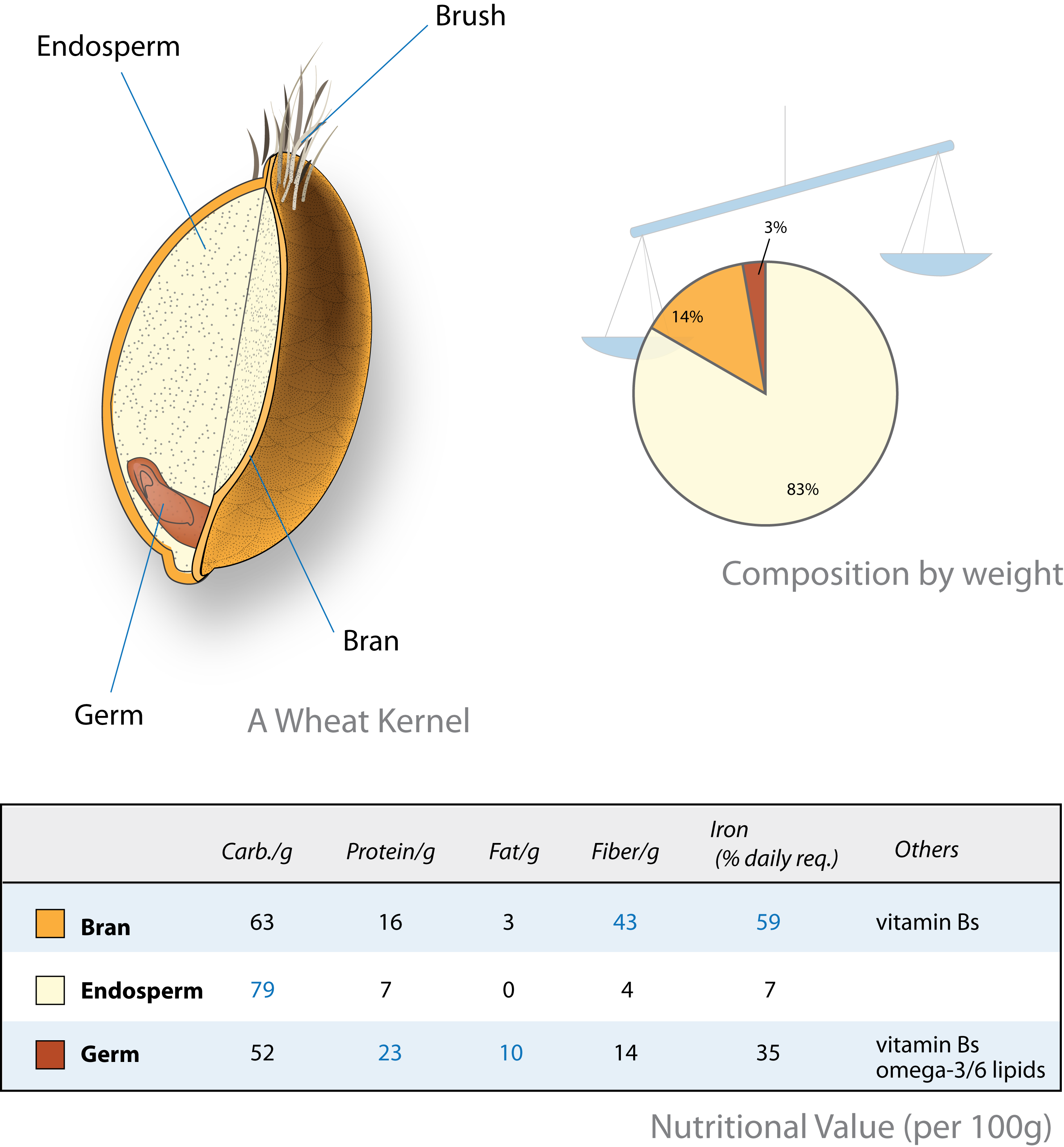
But first, what exactly is the difference between the two? From first glance, all you can really see is the color; whole grains are brown, refined ones are white. So what? Well, the reason whole grains are brown is because of the milling process for the grains. There are three parts of a kernel of grain: the bran, endosperm, and germ.


During the milling process, there are two options. You can remove the bran and germ, keeping only the endosperm. This is what refined, "white" flour is made of. Or, you can keep it all and just grind it up to make whole wheat flour. A very intuitive name when you think about: using the whole kernel = whole wheat flour.

Losing the bran and germ in the production of white flour means a couple of things, though. First, the bran and germ is where all nearly all of the fiber in the grain is: nearly 95%. This key little reason is why white bread does such fun things as spike your blood sugar and make you gain weight easier: because it has almost no fiber to slow your body from absorbing the carbohydrates once you eat it. This can be a problem for everyone except maybe those annoying individuals who seem to be able to eat anything they want and never gain weight. If you're diabetic, looking to lose weight, or just looking not to gain it, white "refined" grains pose a problem. Refined grains are actually absorbed into your body at a rate closer to simple table sugar than anything else.

Pictured: white bread.

Another thing about removing the bran and germ to make refined grains is what you leave: the endosperm. The endosperm doesn't have nearly as much in the way of nutrition as the other parts of the wheat kernel. Because of that, companies that make refined grain products are required to fortify them with five different nutrients: folic acid, riboflavin, thiamine, niacin, and iron. These are only the ones that are required to be added, though: they are not the only ones that are lost. So when you are eating refined grains, you are losing out on some of the nutrition that you could be getting from whole grain foods.

Whole grain products are definitely better for you from a diet and health standpoint, but here's the big question: are they all they're made out to be? Many, many studies have shown that eating whole grains instead of refined ones can do all sorts of good things for you, such as lowering the risk of obesity, stroke, heart disease, and all sorts of other little evils in your body.
These are all great reasons to, when you can, make the switch from refined to whole grains. It makes your body smile inside.

He just ate some whole wheat bread.

So go for whole grains when you can: but be warned. Food companies are trying to exploit this. They sometimes add small amounts of whole grains into their products of mostly refined grains, just so they can get the label on there and make you think it's healthy. You'll see this label on food items to let you know:


If the label is on something like a 300-calorie donut, though, it's not doing you very much good. Get your whole grains, but be wary about where you find them: there is a lot of false advertising around. Be the smart consumer that I know you are, however, and I'm sure you won't have any problem being on your way to better health!